What are the Benefits of a Federal Trademark Registration?

U.S. federal law recognizes trademark rights even without a federal trademark registration. 15 USC 1125(a). Unregistered trademark rights also may exist under state common law. Unregistered trademark rights generally are acquired by using a mark as a source identifier in the sale or provision of goods or services.

If you can obtain trademark rights by simply using the mark without registering the mark, why bother seeking a federal trademark registration? The short answer is that a federal trademark registration strengthens the trademark owner’s rights and provides numerous benefits that are not available without a registration. The long answer is as follows.

Nationwide Protection

Common law rights extend only to the geographic areas where the mark is used in connection with providing goods or services. By contrast, a federal trademark registration provides nationwide rights in the mark, assuming you were the first to use it in connection with your goods or services, without requiring you to provide those goods or services throughout the country. 15 U.S.C. §§ 1057(b), 1115(a).

In a trademark lawsuit, establishing common law rights typically requires you to prove the geographic scope of your use of the mark, including your sales. Gathering evidence of that geographic scope can be burdensome. By contrast, if you have a federal registration, you may be able to rely at least in part on the registration’s nationwide protection without having to show use throughout the United States.

Avoid the Race to Market: Priority Against Later Users

Filing a trademark application that ultimately matures into a registration gives the owner priority as of the application’s filing date.

15 U.S.C. §1057(c) provides in part “Contingent on the registration of a mark on the principal register provided by this chapter, the filing of the application to register such mark shall constitute constructive use of the mark, conferring a right of priority, nationwide in effect, on or in connection with the goods or services specified in the registration against any other person except [prior users of the mark, and prior trademark application filers].”

Therefore, the filing of a trademark application that becomes a registration, provides the owner with superior, priority rights, against users that start use of the mark or that apply to register the mark after the owner’s application is filed.

If you are not using the mark yet, you do not have to rush to establish trademark rights through use. Instead you can file an intent-to-use trademark application. If that application later matures into a registration, it can provide superior rights, assuming the mark is otherwise registrable, against users who begin using the mark after the application is filed, even if those later users begin use before you do.

Persuasive Power of the Registration Certificate

The registration certificate is prima facie evidence of the validity of the trademark owner’s exclusive right to use the mark in commerce in connection with the goods and services identified in the registration. 15 U.S.C. § 1057(b). If you need to send a cease and desist letter to an infringer, attaching a certificate of registration can make the demand more persuasive, particularly for recipients who are unfamiliar with common law trademark rights, as compared with asserting rights based solely on use without registration.

Provides Constructive Notice of the Registrant’s Ownership Claim

A registration provides constructive notice to others of the owner’s claim of ownership of the mark. 15 U.S.C. §1072. Constructive notice means that others are deemed to have known about the owner’s claim of ownership, even if they did not actually know of it. This can strengthen the owner’s rights in a dispute.

Strengthens Trademark Rights Over Time

A trademark registration that has been registered for more than five years is no longer vulnerable to certain validity challenges, including descriptiveness. 15 USCS § 1064. As a result, a long-held registration may eliminate some defenses that an alleged infringer might otherwise raise. That, in turn, strengthens the trademark owner’s position.

In addition, after five years of registration, a trademark owner has an opportunity to obtain the status of “incontestability” by filing a Section 15 declaration provided that, among other requirements, the mark has been in continuous use for five years. Once a mark becomes incontestable, it can no longer be challenged on certain grounds. 15 U.S.C. §§1065, 1115(b)

Customs Assistance Against Importation of Infringing Goods

A federal trademark registration enables the owner to obtain the assistance of the U.S. Customs and Border Protection to prevent importation of infringing foreign goods from abroad. 15 U.S.C. §1124.

First Step to Simplified Foreign Trademark Protection

A federal registration provides a basis for using the Madrid Protocol’s streamlined process to seek trademark protection in foreign countries. 15 U.S.C. §1141b. To file a Madrid protocol trademark application at the USPTO seeking protection in foreign countries, you must first have a pending U.S. trademark application or an active U.S. registration for the mark.

Defense to State and Common Law Dilution Claims

A federal trademark registration is a defense to state or common law claims of trademark dilution. 15 U.S.C. § 1125(c)(6).

Court Characterization of Registration Benefits

The Supreme Court said “Federal registration …. confers important legal rights and benefits on trademark owners who register their marks.” The Federal Circuit Court of Appeals has likewise observed, “These benefits [of a federal trademark registration]–unavailable in the absence of federal registration–are numerous, and include both substantive and procedural rights.”

If you are serious about protecting your mark, consider registering it on the principal register.
Weighted Exercise Band Design Patent Infringement Complaint Dismissed for Failure to Identify Defendant’s Product

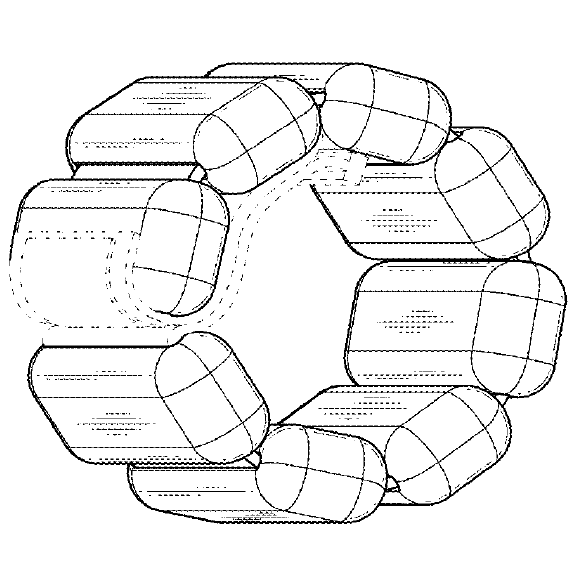
If a design patent infringement complaint does not even identify the defendant’s accused product, it will be dismissed if challenged. Identifying the defendant’s internet store is not enough. A design patent infringement complaint was dismissed and an injunction vacated regarding a weighted exercise band where the complaint merely provided a defendant’s internet store name and a link instead of the name or the picture of the actual product that was alleged to infringe US Design Patent D888,167. Without identifying the alleged infringing product, the complaint only had thread bare allegations that were insufficient to meet the plausibility requirement.

Case: Bala Bangles, Inc. v. P’ships, No. 1:23-cv-16721, 2025 U.S. Dist. LEXIS 190210, at *7 (N.D. Ill. Sep. 26, 2025).

Trademarks Rights Cast a Shadow Over Use of Copyright Expired Content

If you reach out to Disney to see if it will object to your use of Steamboat Willie, you might get an unsatisfactory answer that includes reference to Disney’s claim to hold certain trademark rights. This happened to Morgan Global, who planned to broadcast an ad incorporating an adaption of the 1928 animated short film Steamboat Willie, the copyright to which has expired. Therefore, Morgan sued for declaratory judgement of noninfringement of Disney’s trademarks, and related claims, arising out of the planned use of the adaption of Steamboat Willie.

Even when a copyright is expired, this case illustrates that trademark rights may cast a shadow over use of copyright expired material.

Case: Morgan Global, PLLC v. Disney Enterprises, Inc., No. 6:25-cv-01795 (M.D. Fl. 2025)

Plaintiff’s Claim for $500K in Statutory Trademark Damages Goes Down in Flames for Lack of Support

The court denied plaintiff’s, CELINE SA, request for damages against defaulting defendants stating the “Plaintiff’s requested relief here is entirely baseless” were the plaintiff sought $500,000 in statutory damages per defendant but did not provide any “meaningful description of the circumstances of infringement.” Further, “Plaintiff provides no information about the duration of Defendants’ infringing activity, Defendants’ profits made in connection with the infringing activity, Defendants’ estimated sales volume, Plaintiff’s lost revenue, or the value or reputation of the Celine Trademarks.”

Also, the court denied plaintiff’s motion for preliminary injunction, when plaintiff failed to update it with information received through expedited discovery. The court said “Plaintiff’s decision to seemingly force this case through the litigation process, in the hopes of receiving a handsome payout, is improper and the Court will not reward Plaintiff for these actions.”

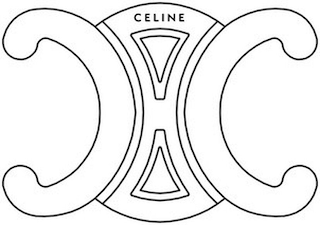
Below is one of the trademarks asserted by the plaintiff for the goods of traveling bags, luggage, and more.

Some judges are taking a critical look at Schedule A cases and finding support for them lacking.

Case: Celine SA. v. P’ships & Unincorporated Ass’ns Identified in Schedule A, No. 1:25-cv-08829, 2025 U.S. Dist. LEXIS 174504, (N.D. Ill. Sep. 8, 2025)

Defendants’ Profits of Less Than $700 Do Not Support Plaintiff’s Claim for $50,000 in Statutory Copyright Infringement Damages

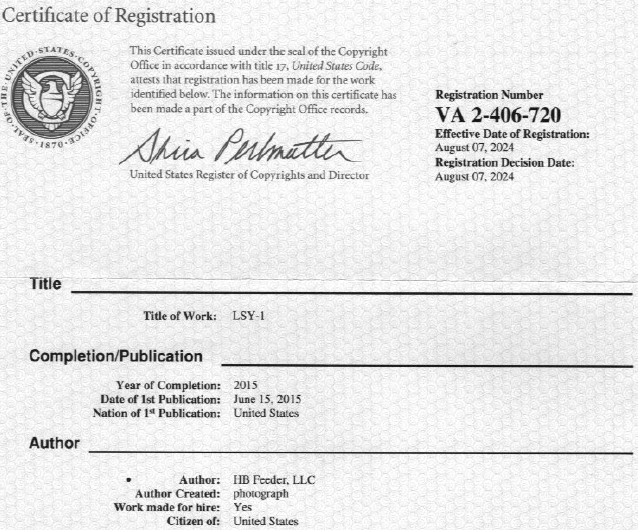
Plaintiff flew too high with its $50,000 statutory damage claim for copyright infringement of its hummingbird feeder images. The court clipped damages to only $1000 per defaulting defendant. Plaintiff failed to explain why $50,000 was appropriate and reasonable in view of the four defendants’ respective profits of $253.77, $666.42, $91.44, and $226.24.

Case: HB Feeder, LLC v. P’ships Identified on Schedule A, No. 25 CV 01359, 2025 U.S. Dist. LEXIS 180111 (N.D. Ill. Sep. 15, 2025).

Insufficient Explanation of Confusion and Plaintiff’s Products Dooms Schedule A Trademark Case

Plaintiff’s motorcycle championship trademark claims in a Schedule A case ran out of gas at default judgment because they lacked sufficient factual detail. The complaint alleged that the defendants’ use of plaintiff’s MOTOGP trademarks to sell counterfeit products caused confusion. But, the complaint failed to provide facts explaining how or why a consumer would be confused. Also, the court faulted the plaintiff for not providing a description of plaintiff’s genuine products. Therefore, the court denied default judgment and released defendants’ financial accounts.

Case: Dorna Sports v. Individuals…on Amended Schedule A, No. 24 CV 11676, 2025 U.S. Dist. LEXIS 177866, at *1 (N.D. Ill. Sep. 11, 2025).

*Note: The court used the words “ordinary observer” in stating “Plaintiff fails to provide any actual facts explaining how or why an ordinary observer would be deceived.” That’s a design patent claim reference. But it is consumer confusion that is considered in trademark cases.

Shipping options to Illinois not enough alone to confer personal jurisdiction in Schedule A trademark case

Screenshots of purchase pages on Walmart’s e-commerce platform showing shipping options to Illinois were not enough to confer specific personal jurisdiction over defendants in a Schedule A trademark case. There was no evidence of an actual sale to Illinois residents, written confirmation of sales with an Illinois shipping address, or shipping confirmation to an Illinois address. Therefore, the case was dismissed for lack of jurisdiction.

The plaintiff claimed ownership of trademarks including LUCKY 13 used in connection with clothing and that the defendants were selling counterfeit LUCKY 13 products. But without evidence of sales to Illinois, its luck ran out when it sought default judgement against the defendants.

Case: Blue Sphere, Inc. v. Individuals, No. 25 CV 004715, 2025 U.S. Dist. LEXIS 176670 (N.D. Ill. Sep. 10, 2025).

Claims Should Reflect the Described Computer Improvement to Avoid Patent-Eligibility Rejection

When an invention improves the functioning of a computer it has a better chance of avoiding a section 101 patent eligibility rejection. The USPTO will typically look to the description in the patent application for the details of the improvement. MPEP § 2106.05(a). Yet, not only should the description explain the details of the improvement, but the improvement should be reflected in the claims.

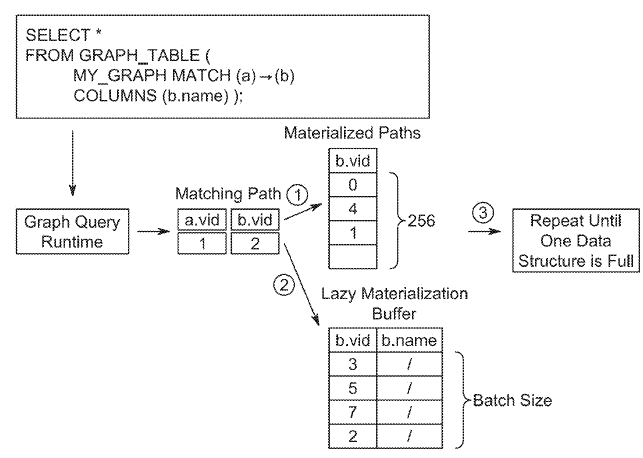
In a patent application by Oracle, the PTAB found the improvement was not reflected in the claims. The application involved techniques for processing graph queries, which may be used in connection with relational database systems.

However, the PTAB found that the claims did not require the improvement of amortizing the initiation of storage operations across entries or a lazy materialization buffer that was discussed in the specification. The PTAB stated, “The addition of an entry in the second data structure, without further limitation, only reflects an idea to specifically amortize retrievals that reduces storage access requests but not a particular solution or a particular way to specifically amortize retrievals that reduces storage access requests.”

Ensuring the described improvement is reflected in the claims will better position a patent application to avoid or overcome a patent eligibility rejection.

[Case: In re HAPRIAN, App. No. 17/162,564 (PTAB)].

Similar Trademark Meaning Alone May Not Be Enough

The TTAB considers the appearance, sound, meaning, and commercial impression of two trademarks when considering whether there is a likelihood of confusion between them. Similarity in any one of appearance, sound, meaning, or commercial impression can result in a finding that the marks are similar. However, when the similarity is only present in the meaning, that might not be enough, depending on the circumstances to find that the marks are similar.

In the case involving the marks APPARITION and PHANTOM for wine, the TTAB found that while APPARITION and PHANTOM were synonyms with overlapping meanings at least in one sense of each term, this was not enough for the TTAB to find that the marks were similar. The marks lacked similarity in sound and appearance. Further, “Given that ‘phantom’ and ‘apparition’ each have additional meanings that differ from their shared meaning, the two terms could stimulate different mental reactions in the minds of the relevant consumers when the terms are applied to wine, thus engendering different commercial impressions overall,” the TTAB said.

While in some cases “similarity in connotation or commercial impression alone may be sufficient to find marks confusingly similar, despite differences in sound and appearance,” here that similarity was not enough and the TTAB dismissed the opposition.

Case: Bogle Vineyards v. Sixmilebridgevineyards, Op. No. 91276339, 2025 TTAB LEXIS 387 (TTAB).

Specimen Showing Downloadable Software for a Trademark Application

The USPTO distinguishes between downloadable software and non-downloadable (e.g. web-based) software, placing them in different classes of goods/services. When claiming downloadable software in a trademark application, the USPTO looks for a specimen evidencing the software is downloadable. Typically that occurs via a specimen showing a “download” or similar link.

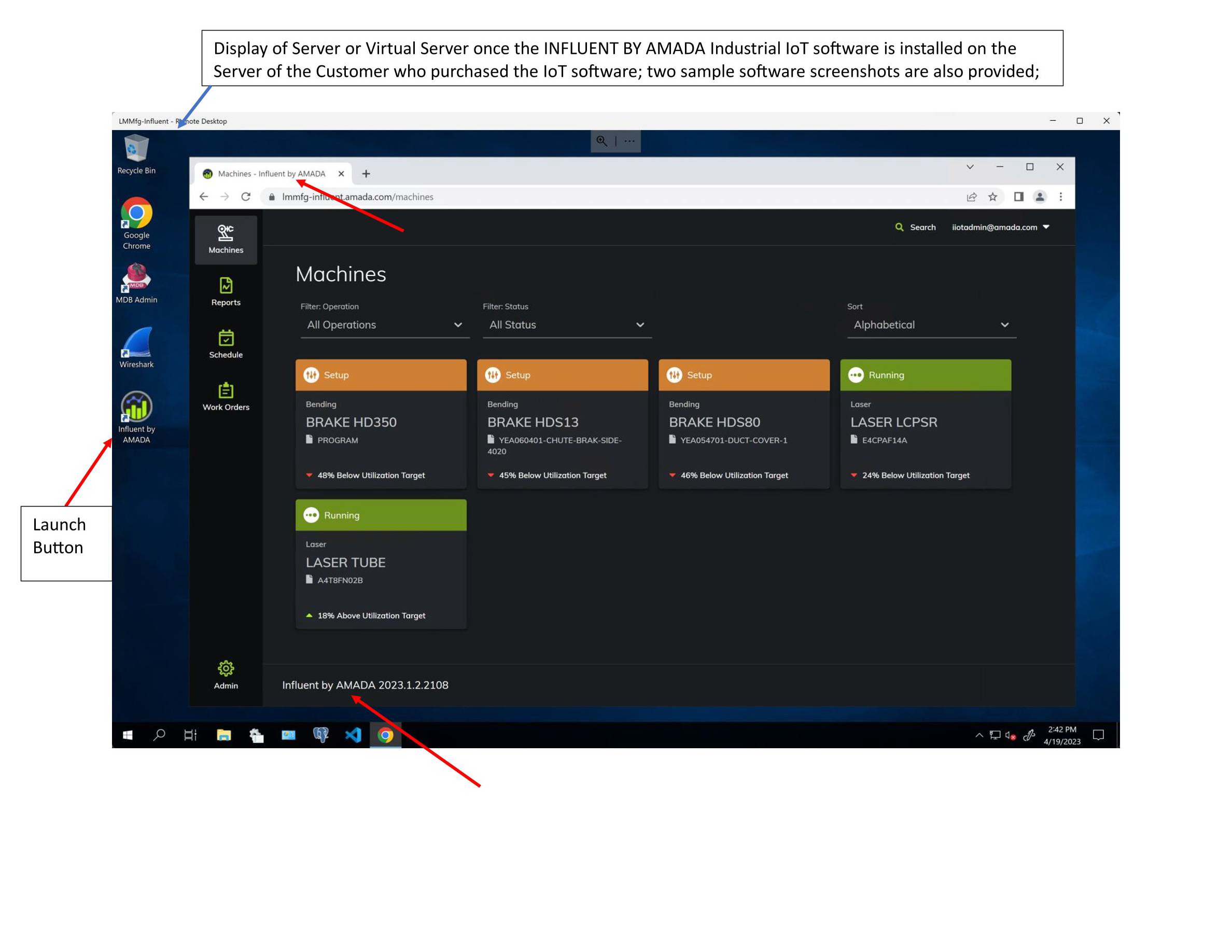
In a recent case, the TTAB of the USPTO rejected the applicant’s specimens, finding that the specimens did not demonstrate the software was downloadable. One of the annotated specimens (below) showed that the icon to launch the software opened a web browser. The TTAB said, “Showing that the software is accessible via a web browser may not necessarily preclude the fact that the software may be downloadable; however, only showing the software accessed via a web browser does not effectively show the downloadable nature of the software.”

[Case: In re Amada Am., 2025 TTAB LEXIS 364, Serial No. 88322796 (TTAB 2025)].