Viewing Patent Application Status and History at USPTO Online with PAIR

Update: The USPTO retired Public PAIR on August 1, 2022. The file history and status of a US patent or published patent application can be accessed via USPTO’s Patent Center at https://patentcenter.uspto.gov.

USPTO_Public_PAIRThe USPTO provides online access to the file history and the current status of patents and published applications through a system called PAIR (Patent Application Information Retrieval). The file history, sometimes called the file wrapper, is a record of all the documents filed by the applicant and the USPTO regarding a patent or patent application. Review of the file history can be helpful in many circumstances to understand more about what the applicant said to the USPTO, during the prosecution of the application. You can also determine the status of a published application or patent using public PAIR.

Here’s a navigation table to make it easier to skip to the sections that are of interest.

  1. Access and Logging in
  2. Bibliographic Data (Application/Patent Status)
  3. Transaction History
  4. Image File Wrapper (Downloadable Files)
  5. Continuity Data
  6. Maintenance Fees
  7. Published Documents
  8. Address & Attorney/Agent
  9. Display References
  10. Conclusion

1. Access and Logging In
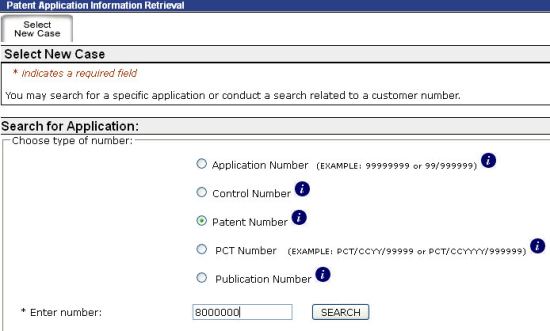
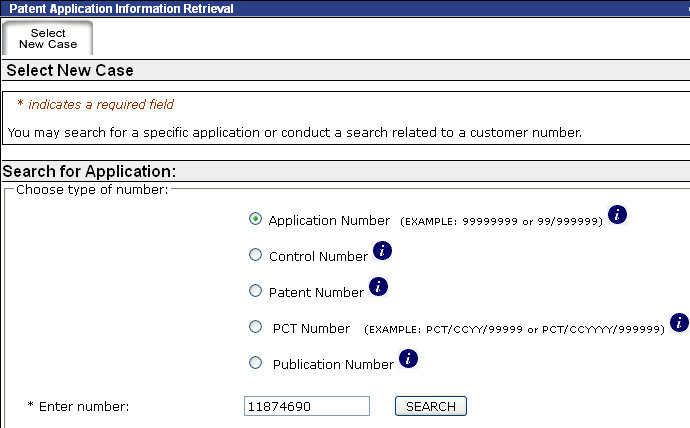
Currently you can access public PAIR by going to http://portal.uspto.gov/pair/PublicPair. Then you will be asked to enter text/characters at the CAPTHCHA stage. Next, you will see a page with a portion showing a tab “Select New Case”. There you have five options for the type of number you will enter in the search box: (1) the patent application number, (2) a control number, (3) the patent number, (4) a PCT number, (5) a publication number. Select the correct option for the number you will enter. Then enter the number in the search box and press the search button.

Patent Number. As an example, I selected the patent number option and entered 8,000,000 in the search box to retrieve the file history of U.S. Patent No. 8,000,000.
PAIRLogin2

Patent Application Number. Alternatively, I could have selected application number and entered 11874690, which is the application number that corresponds to U.S. Patent No. 8,000,000. If you are looking up your own published patent application, you can select application number radio button and enter your application number. If your patent application has not yet published as an application, you will not be able to access it through public PAIR.
PAIRLogin_app2

Back to the Top

2. Bibliographic Data (Status)
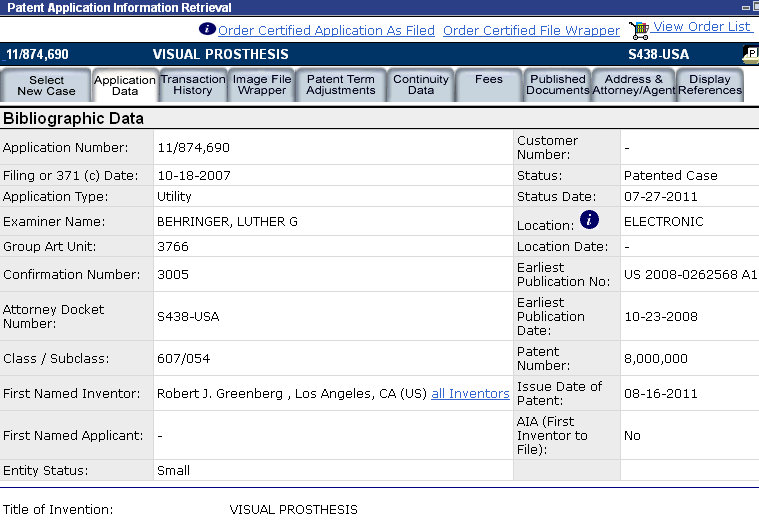
Next you are presented with the Bibliographic data under the application tab. Bibliographic data contains the application number, the filing date, the application type, the Examiner, the group art unit, the attorney docket number, the class and subclass of the application, the inventor’s name, the entity size, the status of the case, the date of the status update, the location, the application publication date, the application publication number, the patent number, the patent issue date, whether the application was/is subject to the America Invents Act, and at the bottom, the title of the invention.
Pat8000000_BiblioData

Back to the Top

3. Transaction History
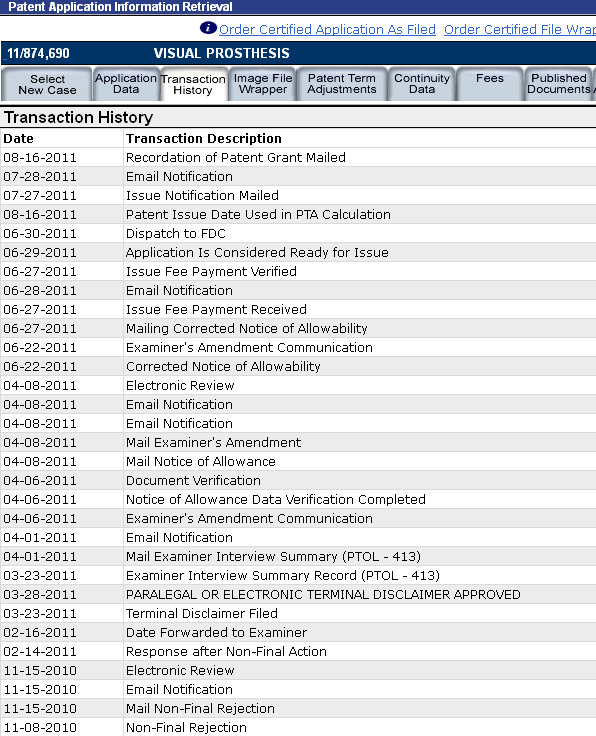
The transaction history tab shows all the transactions in the case, including items filed by the applicant, and process flows and happenings at the USPTO regarding the application. The transaction history does not provide any links to documents, those are found in the Image File Wrapper tab.

The Transaction history can show you internal happenings at the USPTO related to the case that do not show up as filed documents in the Image File Wrapper tab. For example, as shown below the applicant’s response, which is filed on 2-14-2011, was forward to the Examiner on 2-16-2011.  However, this forwarding notation is not found in Image File Wrapper tab.
PAIR_TransactionHistory
Back to the Top

4. Image File Wrapper
The USPTO started providing electronic file histories at the USPTO in 2003. If the patent application was filed before 2003, the file history might not be available online. In that case, you will need to goto the USPTO or hire a service, such as ReedTech, to goto the USPTO for you and copy the file history.

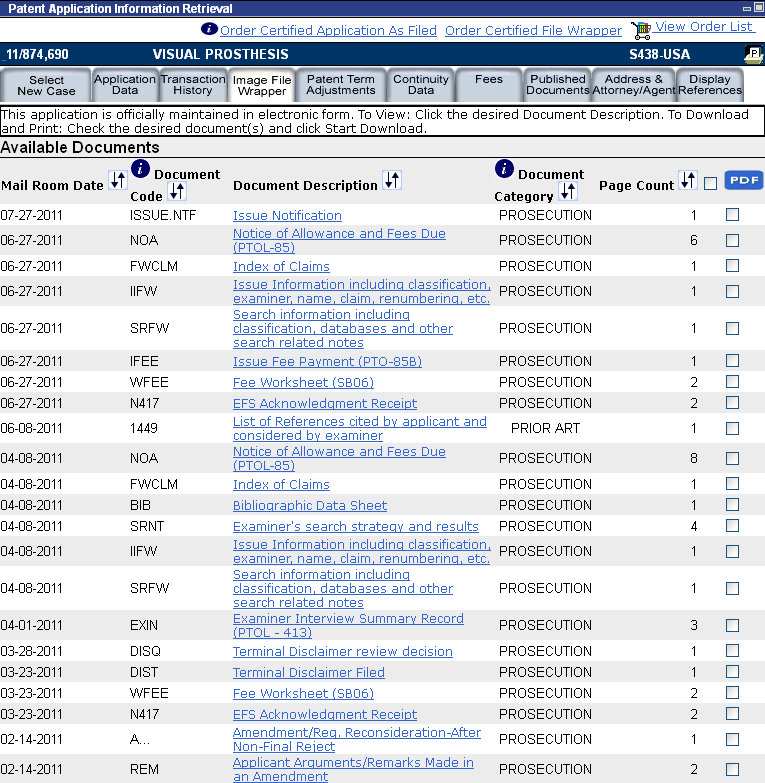
The image file wrapper tab shows all the documents filed by the applicant or issued by the USPTO in the case. The file wrapper tab also allows you to download the documents filed in the case in PDF format, by selecting the corresponding check-box and clicking the “PDF” icon at the top right.
PAIR_ImageFileWrapper

Non-patent literature (NPL) is viable in the history but not downloadable via PAIR over copyright concerns, e.g. that easy access to these documents will facilitate copyright violations by the public and negatively impact the copyright holders ability to charge for these works. NPL are prior art documents filed by the applicant, such as journal articles, excerpts from books, or other publications. On the image file wrapper tab you can see (not shown above) the NPL in the case of US Patent 8,000,000 was filed on 1-08-2009 and the check box for selecting and downloading at the right is grayed-out.

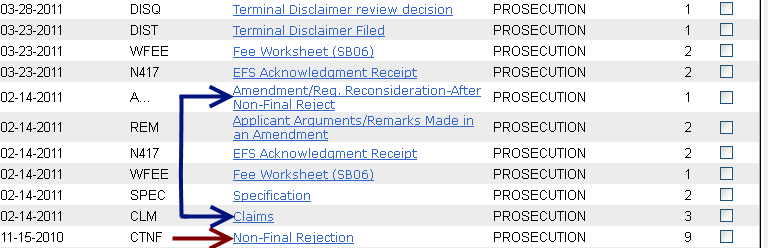
Looking at the image file wrapper for US Patent 8,000,000, we see that the USPTO issued a non-final rejection on 11-15-2010, which was the third rejection in the case (see the non-final rejection on 3-06-3009 and the final rejection on 7-17-2009). On 2-14-2011 the applicant filed a response presenting remarks having arguments for patentability, amendments to the specification, and amendments to the claims. The response on 2-14-2011 was successful in overcoming the Examiner’s refusal of 11-15-2010 because on 4-08-2011 the USPTO issued a Notice of Allowance (NOA), the applicant paid the patent issue fee on 6-27-2011 and the patent was issued on 7-27-2011.
FileWrapperPAIR
Back to the Top

5. Continuity Data
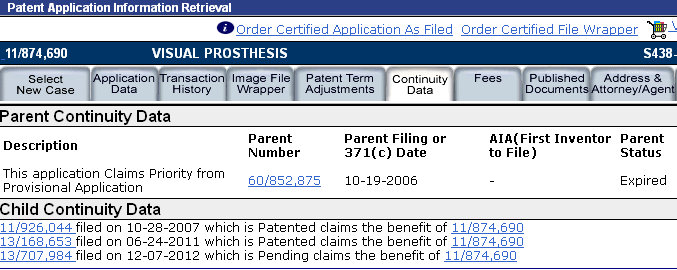
The Continuity Data Tab provides information about related patents or patent applications.
 Pat8000000_ContinuityData

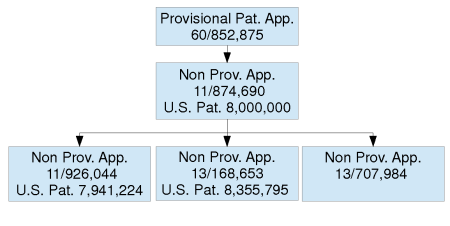
The application that resulted in US Patent 8,000,000, claimed priority to an earlier provisional patent application no. 60/852,875. Also downstream from the US Patent 8,000,000, are three patent applications (11/926,044, 13/168,653, 13/707,984) that claim priority to the application (11/874,690) that resulted in US Patent 8,000,000.
USPAT8000000_ContinuityData
Back to the Top

6. Maintenance Fees
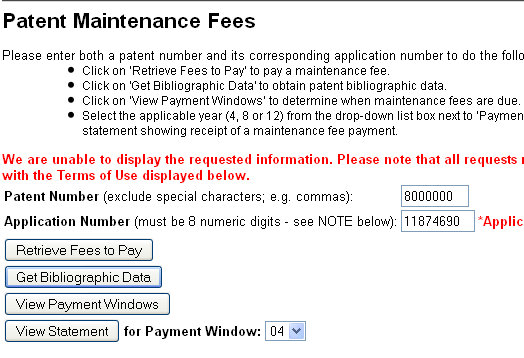
For utility patents, patent maintenance fees must be paid at 3 1/2, 7 1/2, and 11 1/2 years after the patent issues. If a patent has issued you can click on the Fees tab, where you are taken to the USPTO maintenance fee page.
USPTOMaintenanceFeesWindow

You must enter the patent number and the corresponding application number in order to retrieve maintenance fee information. Here the patent number is 8000000 and the corresponding application number is 11874690. By clicking the “view payment windows” a window similar to the following will be displayed.

Pat8000000USPTOMaintenanceFeesWindows

As the USPTO currently provides a six month grace period after the 3 1/2, 7 1/2, and 11 1/2 year deadlines, the USPTO references 4th, 9th, and 12th years rather than 3 & 1/2, 7 & 1/2, and 11 & 1/2 years. The widow when the payment can be made opens six months before the 3 1/2, 7 1/2, and 11 1/2 year date. The USPTO charges a surcharge for payments made in the six month grace period. Therefore the surcharge date is the day after the 3 1/2, 7 1/2, and 11 1/2 year date. The close date is 6 months after the 3 1/2, 7 1/2, and 11 1/2 year date.

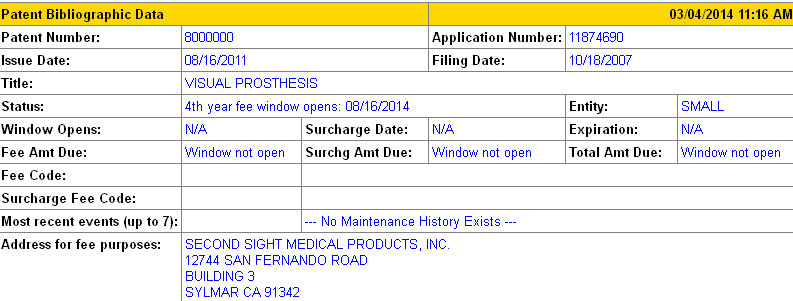
By clicking on the Get bibliographic Data button, you will receive information about whether any maintenance fees have already been paid. In the case of the Patent 8,000,000, no fees have yet been paid.
Pat8000000USPTOMaintenanceFeesBiblio

Back to the Top

7. Published Documents
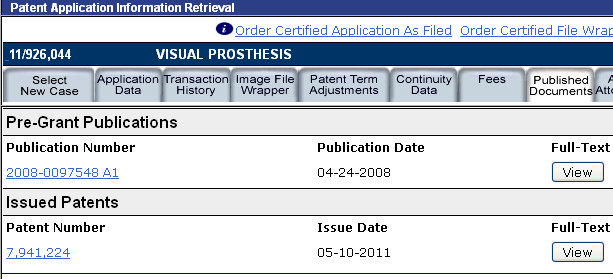
The published documents tab provides a list of publications related to application 11/874,690. In this case, the application was published as an application as US Pat Pub. 2008/0097548 A1 on April 24, 2008 and was published as a patent as US Pat 8,000,000 on May 10, 2011.
Pat8000000USPTOPublications
Back to the Top

8. Address & Attorney/Agent
The Address & Attorney Agent tab provides the current correspondence address for the patent or application as well as information about the patent attorney or agent representing the patent applicant / owner.
Back to the Top

9. Display References
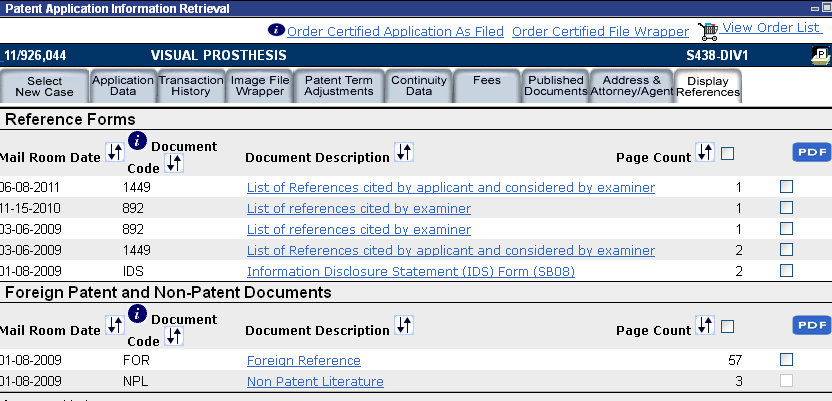
The display reference tab provides documents containing prior art references (such as patents, patent applications, publications, etc). This is a subset of the documents downloadable from the image file wrapper tab. The NPL is not downloadable as you can see that the box is grayed-out next to the NPL in the screen view below.
Pat8000000_PAIR_References

Back to the Top

10. Conclusion
Whether you want to check the status of your patent application or you want to learn more about an existing patent or published patent application, USPTO’s public PAIR system provides detailed information about such applications and patents.
How Can A Delay in Getting A Patent Help Me?

International Airport Board Close-Up with Delayed FlightsMany inventors are shocked to find out that once their patent application is filed, it may take one or two years before the US Patent Office acts on the application, and perhaps another one or two years after that for a patent to be granted (unless an accelerated request is made). This is due to the backlog of work at the US Patent Office.

Does a long delay between the filing date of the application and the patent issue date hurt the inventor’s plans to exploit his invention? What if someone sees his product, copies it and sells it before the inventor has his patent?

Short Commercial Life
For inventions that have a short commercial duration, a long period of time between patent application filing date and patent issue date can be harmful. For example, if an invention was only useful for a particular model cell phone and not useful after the cell phone is replaced by a new model, the long delay could be detrimental to commercial exploitation of the invention, in that a copier of the invention could not be stopped before the commercial life of the product has already dried up.

Longer Commercial Life
However, for most inventions, the commercial viability of the invention lasts well beyond 3 or 4 years. In this case, the delay at the Patent Office to issue a patent is not necessarily detrimental and can work in the inventor’s favor. For example, once an application is on file, the inventor can exploit his invention by advertising, offering the invention for sale over the Internet and undertaking other commercial activities to create a market for the product. This is expensive. On the other hand, the costs of obtaining the patent are spread out and delayed.

Copier Makes a Market
During this “patent pending” period a copier is free to copy the invention since the inventor does not have an issued patent (except in certain usual circumstances). However, the copier will also spend money on creating a market for the product. The copier may be a company that is in a better position to advertise and create consumer demand for the product than the inventor. The copier could market the product for a few years before the inventor’s patent issues.

Patent Owner Takes Over Market
However, if and when a patent issues a few years later, the inventor will be in a favorable negotiating position with respect to the copier. The inventor can sue to stop further sales by the copier and take over the market share for the product that the copier created. Alternatively, the inventor can offer the copier a patent license at a higher rate since the copier has already invested money in developing and marketing the product and is more likely to accept such a license. Still further, particularly in the case where the inventor is not selling a product but wishes to sell the patent, the inventor can offer to sell the patent to the copier at a higher price since the inventor can otherwise sue the copier to stop further sales. The copier would also have an incentive to purchase the patent since the copier can now enforce the patent against other copiers.

Additional Time Added on End of Term
It should also be noted that the term of a US Patent is 20 years from the application filing date. If the duration to obtain the patent was delayed by the Patent Office more than three years from the filing date, the Patent Office grants additional time onto the term of the patent to make up for the delay. In effect, time is added onto the back end of the patent term which is typically more valuable than time at the front end of the patent term.

Beneficial Delay
For some inventors and companies, a delay in obtaining a patent due to the backlog at the Patent Office may actually be beneficial.

What is Trade Dress?

CocaColaBottle

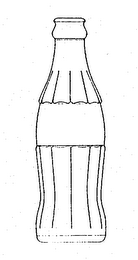
Trade dress recognizes that product/service packaging or the product appearance itself can act as a source identifier in the same manner as more traditional trademarks, like names and logos. In other words, in some circumstances the product packaging or the product appearance can be so uniquely tied to one company or source of goods/services that the packaging or the product appearance indicates to the customer the source of the goods/services. Many times the trade dress of a product allows the consumer to recognize the source of that product from the product packaging or the product appearance alone without any brand or logo appearing with it.

Product and Service Packaging
One example of product packaging trade dress is the classic Coca Cola bottle shape. Coca Cola has a registered trademark (Tm. Reg. No. 1,057,884) over the shape of the classic Coca Cola bottle, as shown at the top of this post. The Coca Cola bottle shape has been used since 1916. Given the unique shape and Coca Cola’s long and exclusive use of this shape for packaging cola, the purchasing public has come to recognize the shape of that bottle as associated with Coca Cola, even if the Coca Cola name is not on the bottle. Product packaging can also cover traditional box package styling. However, aspects of a service “packaging” can also be protected, such as the appearance and decor of a restaurant.  This is not an exhaustive list, basically any packaging or “dressing” of a product or service might qualify as trade dress.

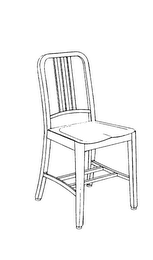
NavyChair
Tm. Reg. No. 2,511,360

Product Design
Trade dress rights can be generated in the design of the product itself, separate from the product packaging. Generally it takes a longer amount of time and/or more marketing efforts to generate trade dress rights in the shape of a product. One, somewhat controversial example of registered product design trade dress is that of the Navy Chair by Emeco Industries (Tm. Reg. No. 2,511,360). The Emeco Navy Chair is an example where a company has had a long period of use of the product shape. Emeco claims to have sold the Navy Chair since 1978.

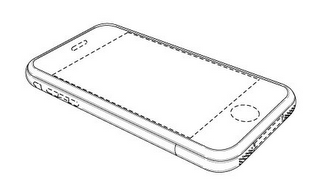
An other example of product design trade dress is the configuration of the iPhone being rectangular with rounded corners as shown in Tm. Reg. No. 3,457,218 (“the ‘218 registration”). Apple used this design since 2007 and it was registered in 2008. This is a very short time for a product design to achieve trade dress protection. However the Trademark Office was convinced that the shape had become distinctive .

iPhoneTradeDressReg
Tm. Reg. No. 3,457,218

In Apple’s application to register this trade dress, Apple claimed that the extensive media coverage of the launch of the iPhone, including front page coverage on national newspapers and lead stories on TV news broadcasts, amounted to about $400 million in free advertising. Further, Apple claimed 1 million iPhones were sold in the first 74 days after the product was launched. Apple cited leading trademark scholar Thomas McCarthy’s treatise McCarthy on Trademarks for the proposition that no minimum amount of time is necessary for a mark to achieve distinctiveness in the marketplace. Massive TV and print advertising campaign can promote a trademark or trade dress to distinctiveness within a matter of days or weeks in certain circumstances. Currently Microsoft is challenging the validity of this ‘218 registration at the trademark office.

IphoneColor
Tm. Reg. No. 3,470,983

Apple has a second trade dress registration (Tm. Reg. No. 3,470,983, “the ‘983 registration”) that is more narrow in that it includes more elements than is shown in the ‘218 registration. The ‘983 registration includes color and various elements of the iPhone home screen, whereas the ‘218 registration claimed only the exterior shape of the product. In the Apple v. Samsung lawsuit, in response to Questions 12 and 15 of the Verdict form, the jury found that the trade dress of the ‘983 registration was valid and infringed by some of Samsung’s products.

Trade Dress and Patents
Patents traditionally protect product designs. However, in some cases the product design in not patented. In such cases, trade dress rights might be used to prevent copying of the product design. Therefore trade dress rights can sometimes be used as a quasi-substitute for patent protection. In other cases, when a patent exists over the product design at issue, both trade dress and patent rights might be asserted to prevent copying.

Conclusion
The packaging or the product itself can be protected under trademark law if such packaging or product becomes distinctive in the minds of the consumers so that it is associated with a single source (e.g. your company). Often it can take a period of time for such trade dress rights to develop. However, there is no set period of time, and recognition can be achieve in a short time depending on the extent to which customers have been exposed to the trade dress.

How long does it take to get a patent?

There are a number of factors that effect the time until you receiving a patent as explained below.

Patentability Searching:
First, if you choose to have a patentability search performed by our office, that generally takes 1 to 3 weeks to complete, depending on the volume of search results and the workload at the time.

Patent Application Drafting:
If we receive all the information about your invention before we start drafting your invention, on average it will take between two to four weeks to draft the application for your review. If shorter time frames are needed, we will strive to achieve a timeline that works with your schedule. In a past expedited circumstance, we were able to file an application within 2-4 days after receiving all the required information about the invention. The time frame within which we could draft a patent application depends on our present workload, the complexity of the invention, and the amount and type of information provided by the client before drafting begins, as well as the number of changes provided by the client after drafting begins. After the patent application is filed you will have “patent pending” status in the United States.

After Patent Application Filing
After filing, the length of time to patent grant depends on whether you begin with a provisional or a non-provisional patent application in the United States. If you begin with a non-provisional patent application, the U.S. Patent and Trademark Office (USPTO) will place your application in a queue to be examined by a Patent Examiner when the USPTO receives your complete non-provisional patent application.

The present (2019) average wait time until the USPTO provides us with the results of the Patent Examiner’s first substantive review and examination (average pendency to first office action) of the patent application is about 16 months. The average time it takes to obtain a patent from the patent office at this time is about 24.1 months or about 2 years. [See the current wait time statistics at the USPTO website [here] (best viewed with Internet Explorer or Chome)].

The actual amount of time it will take for your patent application to be examined, and if found allowable, to issue into a patent will vary. Some technical areas have a longer or shorter wait time because the USPTO groups patent applications based on the invention’s technology and assign patents to technology groups (known as art units) of examiners at the USPTO for examination. If one art unit has more patent applications in the queue than another art unit, then patent applications assigned to the art unit with relatively more patent application will wait longer for examination and ultimate issuance.

If you decide to file a provisional patent application, the patent office will not put your provisional patent application in a queue to be examined. Instead, a non-provisional patent application must be filed within one year of the filing date of the provisional application, in order to claim the benefit of the provisional application filing date. In the case that you file a provisional and then file a provisional on the one year anniversary date of the filing of the provisional, one additional year will be added to the times listed above. This is true because you have waited that 1 year to have the non-provisional application placed in a queue to be examined.

Prioritized Examination
The USPTO offers a prioritized examination (also known as Track One) for utility and plant patent applications for a limited number of patent application per year. To be considered for the prioritized examination, the applicant must pay additional fee to USPTO. Under the prioritized examination procedure the USPTO assigns a priority status to your application. The USPTO aims to get to a final disposition (allowance or final rejection) of your patent application within 12 months of the prioritized status being granted.

Patent Pending
While your patent application is pending (after the patent application is filed but before the patent is granted) you will have patent pending status. You are not required to wait until you obtain a patent to start exploiting (making, marking, selling, licensing, etc.) your invention. You can begin doing so after the patent application is filed, as long as the patent application fully describes and covers all the elements of your invention that you intend to disclose and use publicly.

How To Choose a Strong Trademark

Trademark Strength

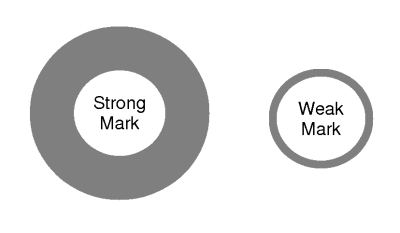
Not all trademarks are equal in strength. The strength of a mark is a measure of the extent and scope of protection provided for the mark under trademark law. As shown in the diagram, strong marks have a bigger buffer or protection moat around them and thus prohibit competitors from operating within that buffer. Weaker marks have a smaller buffer. The smaller buffer allows competitors to use marks that are more similar to a weak mark than would be allowed for a strong mark, all other things being equal. This post explains how to select a strong trademark so you can keep your competitors at a larger distance from you in terms of the similarity in the marks that competitors use.

A strong mark is one that has a greater level of distinctiveness in relation to the product or service with which it is used.A strong mark should be distinctive rather than descriptive. Descriptive marks that merely describe the goods or services that the mark is used on or in connection with are difficult to protect during initial use. The reasons for this are: (1) to prevent the owner of a mark from inhibiting competition in the sale of particular goods; and (2) to maintain freedom of the public to use the language involved, thus avoiding the possibility of harassing infringement suits by the registrant against others who use the mark when advertising or describing their own products.

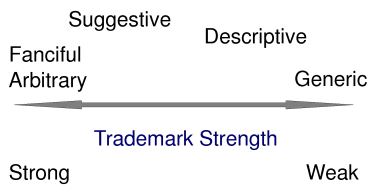
Continuum of Distinctiveness TM_Strength-003
The strength of a mark can be categorized along a continuum, ranging from marks that are highly distinctive (e.g.“Pepsi” for cola) to marks that are a generic name (e.g. “coffee”) for the goods or services. The degree of distinctiveness of a mark can be determined by considering it in relation to the specific goods or services. The degree of distinctiveness of a mark corresponds to the degree of protection provided by trademark law. The more distinctive a mark is the more protection provided by law.

Marks that are highly distinctive when used in relation to the goods or services are considered arbitrary or fanciful. Arbitrary and fanciful marks are located on the strong end of the continuum. Next on the continuum are suggestive marks, followed by merely descriptive matter. Last are generic terms. Generic terms are at an end opposite arbitrary and fanciful marks.

PespiFanciful marks include terms that are created for the sole purpose of functioning as a trademark or service mark. Such marks comprise words that are generally unknown in the language, such as PEPSI . The word Pepsi did not exist before Pepsi created it and began advertising under it.

Next, arbitrary marks are those that are commonly used but, when used to identify particular goods or services, do not suggest or describe a significant ingredient, quality or characteristic of the goods or services, such as APPLE for computers. The term apple had nothing to do with computers before Apple Inc. began using the term for that purpose.

Suggestive marks are those that, when applied to the goods or services at issue, require imagination, thought or perception to reach a conclusion as to the nature of those goods or services. For example, BEAUTYREST suggests something about the nature of mattresses. beautyrestA suggestive term requires imagination, thought, or perception to reach a conclusion regarding the nature of the goods or services. A suggestive term is different from a descriptive term because a descriptive term immediately tells something about the goods or services.

A mark is merely descriptive if it describes an ingredient, quality, characteristic, function, feature, purpose or use of the corresponding goods or services. Descriptive marks may not be registered on the primary register without proof that the mark is widely recognized by consumers–that is the marks have gained “secondary meaning” in the marketplace. For example, BED & BREAKFAST REGISTRY was found merely descriptive of lodging reservations services. However, American Airlines was likely initially merely descriptive (its an airline that flies in America), but over time has become widely recognized and thus protectable.

Generic terms are those terms that the relevant purchasing public understands primarily as the common or class name for the goods or services, e.g. coffee. Generic terms alone cannot be protected as trademarks. However generic terms are sometimes combined with other terms or components to achieve protection over the combination, e.g. Starbucks Coffee. However, the Starbucks Coffee trademark cannot be used to stop others from using the term coffee alone or in combination with other terms not similar to Starbucks.

Selecting Strong Marks
The strongest marks are fanciful and arbitrary marks. However, practically these marks require the most marketing resources to create consumer recognition. Suggestive marks provide a middle ground where the mark suggests a feature of the product or service thereby reducing the amount of marketing resources required to inform your customers as compared to fanciful marks, while still providing a reasonable amount of protection under trademark law.

Eric Waltmire Presenting on IP for Dupage’s REV3 Innovation Center

Rev3On March 11, 2014 at 6:30pm, REV3 Innovation Center of Dupage is hosting me for a presentation on Strategies for Protecting Intellectual Property: Innovation and Branding. Intellectual property plays a role in adding value to most businesses, whether through invention, branding, or the use of other creative works.

My presentation will help business owners, entrepreneurs, and inventors understand how patents and trademarks can be used to protect innovation and business branding. It will provide strategies for protecting intellectual property rights under various scenarios and funding circumstances. Sign up here to attend.

Particularly the presentation will cover the following.

Patents and Invention Protection:

  • What is patentable
  • Patent Searching
  • The U.S. Patent Application Process
  • When to maintain secrecy and when to publicize
  • Seeking Foreign Patent Protection
  • When not to seek a patent
  • When and how to rely on trade secret protection

Trademarks and Brand Protection:

  • Value of trademarks
  • Types of marks
  • Strategies for choosing legally strong marks
  • Proper trademark use
  • Strategies for relying on branding in the absence of patent protection

In addition, the presentation will discuss steps that are needed to obtain and maintain ownership over the intellectual property created by your company, its employees, and its contractors.

REV 3 Innovation Center
REV3 Innovation Center is an incubator and future co-working space in DuPage County. REV3 is focused on helping people and companies manufacture products, software, and technology to drive the third industrial revolution. One aim of REV3 is to provide facilities to allow companies to prototype, build, and assemble small and moderate scale product volumes.

If you are interested in getting involved with REV3, please contact me.

Location
The presentation will be held at the Illinois Institute of Technology (IIT) – Rice Campus at 201 E. Loop Rd., Wheaton, IL 60189.

Please sign up to attend here: http://rev3dupage.com/events/?ee=12.

How Do I Reduce Patent Costs?

PatentCostsReduceBelow are some steps that you can take to help reduce the cost for us to prepare a patent application on your behalf. These steps are not required as we can draft an application based on your requirements and information. However, by following the guidelines below you can assist in reducing patent preparation costs. See our separate article for general information about how much a patent costs.

Provide a Detailed Description of the Idea at the Start
It is important that you provide the most detailed written description of your idea. The written description should include drawings. The drawings can be hand-sketched. The written description should make reference to individual parts of the invention shown in the drawings. The drawings should have parts labeled by number. The written description should make reference to the parts by name and number.

Generally, short summaries or brochures do not provide sufficient details about the invention and how it works. If we have to request many details about the invention from the inventor, this adds time to the process and drives up the cost of preparing an application. Another scenario where we generally need to put forth a lot of effort to obtain details about the invention is when the inventor only orally describes the invention and we need to draft the application from the oral description.  When the inventors presents a clear and detailed description of the details of invention, its various functions, and the benefits of the invention as compared other inventions in the field, we are able to most efficiently prepare an patent application on the invention.

Start with a Complete Invention
When an inventor keeps inventing during the time when we are drafting the application, the cost of preparing the application can rise substantially. Description of the new features must be added. Sometimes various parts of the patent application need to be rearranged to account for the new developments. Often times drawings will have to be changed or new drawings created to include the new details not provided in the beginning. Adding details after the application drafting is underway generally takes more time, and generates more costs, than if the details had been provided at the beginning.

Provide a First Draft
We can often provide an example patent application that is in the field of the inventor’s invention. A template can also be provided for the inventor to start from to assist in developing a detailed description of the invention. If the inventor drafts a first draft based on a template provided, cost can be reduced. We can then take this first draft as a base and draft a patent application that meets our standards having all the appropriate language and detail.

The cost to prepare a patent application depends on many factors, however the above guidelines can help reduce the cost for us to prepare a patent application for you.

What is an Invention?

For our purposes, we will focus on patentable inventions. Abstract ideas cannot be patented but many ideas are implemented in a manner (an invention) that falls within what is patent eligible subject matter. There are four general requirements for an invention to be patentable (as a utility patent): (1) it must comprise patent eligible subject matter, (2) it must be new, (3) it must be useful, and (4) it must be non-obvious. Each requirement for a utility patent will be address below. Then the requirements for design patents and plant patents will be discussed.

Patent-Eligible Subject Matter
The subject matter of the invention must fall within one of the patentable subject matter areas set forth by Congress. Patentable inventions include the following: a process/method, machine, manufacture, or composition of matter, or any new and useful improvement thereof. The courts have stated that Congress had intended patentable subject matter to be very broad and may include anything under the sun that is made by man.

New
The invention must be new (e.g. novel). Patents are only granted on new inventions. Patents are designed to encourage inventing and the disclosure of inventions. Therefore if your invention has already been disclosed to the public in certain predefined ways, then you may be prohibited from obtaining a patent over your invention. A patent novelty search is designed to provide you with some information on whether your idea is new and therefore patentable.

However, an invention may be considered new even if the invention includes parts that are old and known. Many (if not most) inventions are an improvement on an old invention. Even the combination of old parts in a new way can be patentable. Similarly a new method of using a known device my be patentable.

Useful
A patentable invention must have a use or utility. This is the most easy element to satisfy. Unless the invention is only useful as landfill, the invention most likely is useful for something.

Non-obvious
The invention must be non-obvious in view of the prior art (prior inventions and publications, among other things). The non-obviousness requirement is intended to ensure that the invention is sufficiently different or new to warrant patent protection. The non-obviousness requirement is not necessarily synonymous with the common understanding of the word “obvious.” The non-obviousness element is very circumstance dependent. Very small changes may be considered non-obvious. You should be sure to check with an patent attorney before concluding that your invention is obvious.

If your invention meets each of the above requirements, then the invention should be eligible for patenting, assuming all of the procedural requirements are met in filing and prosecuting a patent application.

Design Patents
The above requirements are for utility patents. The ornamental design of an article of manufacture may receive a design patent if it is new and original. Therefore like invention of a utility patent, the ornamental design can be protected if it is new and non-obvious. As design patent protection is narrow, even small changes in the ornamental design of an article may received design patent protection.

Plant Patents
Plant patents may be granted to anyone who invents or discovers and asexually reproduces any distinct and new variety of plant.

Use Based v. Intent-To-Use Trademark Applications

There are at least two types of federal trademark applications. The first is a use-based trademark application, also known as a section 1(a) application corresponding to the section of the law that authorizes the application. The second type is an intent-to-use application also known as a section 1(b) application.

Use-Based
A use-based application is one where the applicant is already using the mark in commerce at the time when the application for federal trademark registration is filed. Use of the Mark in commerce can include shipping or selling the goods with the mark or rendering services after advertising those services with the Mark.

Intent-to-Use Based
An intent-to-use application is one where the applicant has not used the mark in commerce or business at the time that the application is filed. The intent to use application allows the applicant to reserve a trademark that they intend to use before actually using it.

This allows the applicant to stake a claim to rights in a name (or other mark) while doing the work that is required to bring the product or service to market. Many preliminary matters such as purchasing supplies, designing logos, designing graphics, designing packaging, and so forth may need to be completed before the product or service can be put on the market. Such activities might require a substantial lead time between the time when the trademark is selected and the time when the products or services are provided. Therefore an intent to use application allows an applicant to reserve a mark so that they do not have a problem running into others who are attempting to register the same or similar name while there working on their product/service start up activities.

Conclusion
A use-based application is for those already using the mark and an intent-to-use application is for those who plan to but are not yet using the mark.

What is a Patent?

PatentA United States patent is a property right granted from the United States government giving the inventor the right to exclude(stop) others from making, using, offering for sale or selling the patented invention in the United States for a limited period of time (usually 20 years from the filing date).

A patent is a type of intellectual property. Other types of intellectual property include: copyrights that protect the expression of an idea, trademarks that protect product and service source identifiers (brands), trade secrets that protect information and other items that have business value and are not generally known.

A patent provides a time limited monopoly over the invention in exchange for disclosing to the public the details and manner of composition of the invention. The monopoly allows you to prevent others from benefiting from your inventive work without your permission. Therefore you may be able to charge more for your product or service that is protected by a patent, than would be possible if your product was not protected and competitors copied your product and competed with you.

This exchange of a monopoly for public disclosure, allows the science area of your invention to be advanced. During and after the time when your patent is in-force others can read about the details of your invention as described in your patent, which might spark other non-infringing ideas which will advance the art/science related to your invention. Therefore you benefit from the monopoly provided by the patent and the public benefits by understanding your invention which can advance related engineering and sciences.

Maintenance fees must be paid by the patent owner at certain intervals in order to keep the patent from expiring before the patent term ends.

A U.S. patent does not provide protection outside of the country. However a U.S. patent can be used to prevent the importation of infringing products in to the United States from abroad. Foreign patents are needed to receive protection in chosen foreign countries.